14 October 2007

Tomato Canning 2007

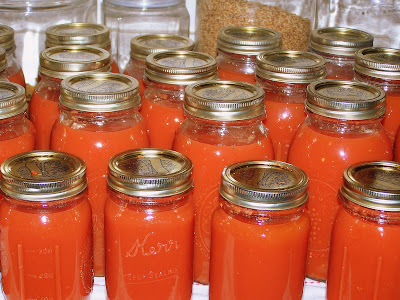
We spent yesterday evening canning tomatoes.

As always, Jack was an immense help. At this point, he is as much help as many adults - -though he still doesn't have the stamina to see how the whole job through. (He generally ends up laying on the floor watching us about halfway through the process.) But he's more and more help each year nd it's gotten to be almost quick and painless. Almost.

It was actually our second bushel for the year, bringing us to almost 50 jars of tomatoes for the year. Last year we ended up with 15, and that just wasn't enough. We ended up "saving them for a special occasion" since we could only treat ourselves to one jar a month -- which meant that we arrived at spring with half of them left. Now we can eat them with abandon -- YES!

We still have two bushels of apples to can. One will be apple sauce -- and we're thinking the other might be apple wedges for crisps and pies. Rod is thinking we'd be best off waiting a few more days to let them ripen further so we'll probably do that next weekend.
Posted by Picasa

13 October 2007

Fossil Park

We went to fossil park near Toledo last weekend, but I couldn't write about it then because, of course, our server was down more down than up.
.


But the technician, a very competent and pleasant young man, was here this morning and we're up and running again.


Fossil park is a public park near Toledo, in Sylvania, Ohio. Admission is free and the place has a ton of fossils to find.

Things to know if you decide to make the trip:
  • Fossil park is basically an old quarry where trucks come and dump loads of shale every two weeks between May and October. The shale has tons of fossils, but you do have to work at finding them.
  • The directions you'll get online don't take yopu to the park, they take you to the ice cream parlour. Once you've wandered around the shopping center for a bit, try crossing Centennial Street (the highway).
  • As an old quarry, it can get *hot* in there. Wear your hat and cover your skin with something light. Also bring water to drink.
  • As an old quarry, the "luxuries" are pretty sparse. There are some reasonably clean portable toilets up the hill from the quarry, and there is some suspiciously dark water for washing your fossils available in a tank in the center of the quarry. That's it.
  • There is no food or drink available at the park, so if you plan to be there a while, you'll want to bring water and something easy to eat with filthy hands. There is, however, a nice Strohs ice cream parlour across the highway as you leave for the day -- YUM!
Jack and Connor had a blast -- but I don't think fossils came into it much -- they had fun running around, banging rocks together and playing in puddles. Even so, they did find a few small fossils. Neal, Connor's Dad, was far more persistent and found *two* gorgeous, complete specimens! It's worth a trip with older kids who grok and the smaller kids won't be too bored -- if only because of the amazement of watching adults playing in the dirt!


Posted by Picasa

10 October 2007

Quotes

The server is up for the moment...but I am running late so this will be quick:


Sunday:
Jack: "Mamma, do you love me?"
Me: "I love you very much, Jack!"
Jack: "Do you love your other children?"
Me: "Oh, yes, I do. I love them all very much."
(pause)
Jack: "Mamma, do you ever wonder who is coming next?"
(long pause)
Me: Well, yes, as a matter of fact I do wonder who is coming next!

Tuesday:
"Mamma, I'm a not a baby anymore. I'm a big boy! Soon I will grow up to be a big man like TJ and Mike! I don't know what I will look like when I am an adult, but Mamma, you can come and visit me and my children every day!"
Where do these things come from??? *laugh*


(Yes, the pants on the head was hilarious for several days...)

08 October 2007

Silence

Sorry about the silence folks. Comcast has become extremely unreliable and so I don't have reliable access to the Internet at home. It's up for an hour or so from time to time, but not often when I am trying to log in. I will write as I can at home and publish through Google documents. It doesn't look as nice (no photos unless I can log in from home), but for the time being I can do it on breaks at work.

04 October 2007

Living with diabetes

Living with diabetes is such a barrel of laughs.

You get to develop the discipline to stick your fingers a half dozen times day, and then to poke a needle into your belly several times day. You exercise a lot of will carefully choosing what to eat based on things other than what would taste yummy -- or opting for yummy and an extra injection. Turning every day, every meal into another grand science experiment on the biology of the endocrine system...

Conversely, you can ignore all of that, suffering deteriorating health and experiencing the reality that diabetes can be a gruesome way to die.

And of course, because there are no promises, turning your life into a grand science experiment can simply make you aware more quickly when things start to go wrong. As an example, I have worked hard to control my diabetes for 11 years now. I have balanced my meals to keep my blood sugar controlled, I have exercised to keep my insulin resistance under control ... and yet earlier this year I found myself restricting foods further and further in a vain attempt to bring my blood sugar down.

One day I had to admit that I was in trouble. A week on basically no carbohydrates had not lowered my blood sugar. Exercise, which used to bring my blood sugar down 50 points or so was having no effect -- and occasionally it was even raising my blood sugar.

Time for a consultation with a doctor...

Anyway, against this backdrop of constant effort for spotty results, you can imagine my frustration with the attitude some uninformed people take.

I had occasion recently to find myself at a luncheon table with several people I don't know. Because the options had been limited at the buffet, I had an odd looking lunch that consisted a slice each of three different types of cold cuts, two slices of fake cheese, and a half a bowl of powdered, reconstituted chicken broth. One of my companions comments on my "eating light", and I mentioned that I was simply trying to eat for my diabetes. (Never mind the HFCS in all the meats and in the broth, we do what we can.)

The conversation at the table quickly went to the subject of all the diabetics everyone knew who "weren't taking care of themselves". Comments about diabetics who "think they can get away with" eating like everyone else. I did my best to point out that high blood sugar makes one insanely hungry for good reason. That it's not so easy to live life ion a constant restricted diet, and that there is no moral credit for and no guarantee for living a life of deprivation.

I don't think anyone heard a word of it.

Worse, it was clear that these people had no clear idea about how to control diabetes themselves -- they hadn't bothered to inform themselves, they were just judging someone else for not living a life of virtuous deprivation. These people sat there eating refined breads, cookies, chips, and pop while trashing friends and relatives for eating exactly the same way!

The one who took the cake? The woman who, between bites of cookie told me "She has no right to eat like it's her birthday every day! I'm an only child and she's making herself a burden on *me*!" I dryly pointed out that if her mother was doing that poorly at caring for herself then her daughter had no reason to worry. Her mother wouldn't live long enough to make a burden of herself. I'm pretty sure she didn't hear me.

I suppose they might have thought that since I test my blood sugar (largely the people they were complaining about didn't - - or didn't admit it to their judges, anyway) and work hard to try to control my blood sugar, that made it OK to trash people who they don't deem 'to be doing a good job' in front of me.

It was hard to choke down my tasteless, nutrition-less lunch. I felt so sad for their relatives and friends...I know I have had friends and relatives who judge without knowing what I know. It makes a tough row even harder. I have to admit that it got to me in the usual way and I ended up eating cheap, nasty chocolate later in the day in a sick kind of rebellion against those who would, in full ignorance, judge. Yeah -- smart, eh?

If you have a friend or relative who is living with diabetes, please don't judge the way they choose to treat their diabetes (or not). Nagging isn't helpful. Want to help? Don't make assumptions that your ideas are really helpful, ask. And remember that no one deserves less freedom of choice because of their health. It may not be the choice you'd make, but in a free country the choice to join in the community of our loved ones by sharing the same foods as everyone else eats is a valid one.

Maybe the best help you could be would be to do some real research about how best to treat diabetes and then make yourself the first member of the community to join your loved one wholeheartedly in the lifestyle and food choices you deem best for them.

Is it too hard for you to make the adjustments you expect your friend or loved one to make? Why?

Hah!

It would seem that I am not the only loon who thinks this way!!!!

Veronica posted a challenge to her readers a few months ago to choose a book from a list of classic stories she provides all of which have been turned into movies.
It doesn’t matter what book or short story you choose, as long as it’s one you’ve never read before. I’ve linked the titles to Amazon if you prefer buying books, but most of these could be found at a public library or interlibrary-loaned.

Read the book and then post about it on Monday, August 20th.

I missed it -- but I ,love that she made the challenge and I intend to borrow her list!

03 October 2007

A Revolution in Nutrition and Health

A Revolution in Nutrition and Health

I attended a conference put on by the Michigan chapters of the Weston A. Price Foundation (WAPF) and it exceeded my expectations in many ways.

The first thing I noticed about the speakers list was the number of these people who are at the very top of their game at an international level in their chosen field. The second thing I noticed was how few of these people are specifically WAPF people.

This told me two things. The local chapters of the WAPF are more interested in nutrition than in evangelism. The conference was likely to be informative, if nothing else.

I can only comment on the lectures I attended, but here goes…

Kathleen Rafter from WAPF West Michigan gave the introductory presentation, outlining the principles of nutrition as promoted by Weston A. Price. She summed up her introduction with a moving testimonial about her own experience, restoring health to her adopted child who entered her care severely malnourished and barely functional. The child is now in great mental and physical health and much of the skeletal malformation has addressed itself.

For those of you unfamiliar with the Price approach to nutrition, it is basically summed up in the notion that highly processed foods of all varieties are the major contributing factors in the deteriorating health of humanity. Price’s research into native cultures (back in the1930’s when many cultures still existed that had not adopted western eating habits) determined that a variety of factors contributed to the optimal health of these people. He was able to determine this by looking at subsequent generations of the same people as they were introduced to modern western “convenience” foods, (all coming under the general classification of “de-natured foods”) while maintaining their lifestyle in other ways. Those who adopted de-natured food suffered from the same maladies as we suffer in the west, those who remained with their native diets did not. Price was also able to observe skeletal differences, which suggests that the de-natured food was causing systemic damage at a fundamental level.

Some of Price’s observations include:
  • Native lifestyles include a lot of physical activity.
  • No grains or legumes are consumed by native cultures that have not been fermented, either by acid treatment or by bacterial means.
  • All native diets include some animal products, largely from pastured animals raised in natural conditions foraging on a diverse range of foods in mineral-rich soil.
  • Native diets contain between 30 to 80 percent saturated fat, mostly from animal sources.
These findings are contrary to popular wisdom, but the case Price presents is compelling.

On to the next lecture…

“Don’t put that in your Mouth:…”- Jeffrey M. Smith

Jeffrey Smith is the author of “Seed of Deception”, and “X-Files” type book that exposes the political graft and industrial corruption that have contributed to the massive use of genetically modified organisms (GMO’s) in the food supply without sufficient testing to determine their safety. More startling is the notion that, when objectively tested, GMO’s are consistently determined to be harmful.

Jeffrey opened his presentation with alarmist facts and great stories, then he changed gears mid-presentation to sound science, or should I say, to what little sound science there is that has been conducted on GMO’s.

The Cornerstone of Jeffery’s talk was the work of Arpad Puszai, the scientist believed to be the best qualified in Europe to determine the safety of GMO’s, who was fired from his position of 34 years and issued with a gag order on his research when he reached the conclusion that GMO’s should not be in the food supply. The subsequent release of his research 7 months later sparked the 180-degree turn-around in the EU about GMO foods.

Jeffrey's conclusion was, somewhat surprisingly, that we really don’t know about the relative safety of GMO’s, but that what little evidence exists at all, suggests that they should not be in the food supply.

I was surprised to hear that, because much of his talk was centered around the negative results of the tests that have been carried out and the apparently clumsy method by which GMO’s are produced. I had expected a conclusion like “there are no safe GMO’s” or something to that effect. The more moderate conclusion gave him greater credence in my view. I purchases his second book, which is called “Genetic Roulette” and outlines the 63 major concerns about GMO’s that arise from sound scientific research. It is a dense volume containing many studies, but has executive summaries for politicians and policy
makers.

The next day started with a discussion about Heart Disease from Doctor Natasha Campbell McBride from the UK.

She firstly dispelled the “diet-heart hypothesis”, which postulated in the 50’s that saturated animal fat was the cause of heart disease.

She explained that arterial plaque is caused by systemic inflammation, which can be directly related to environmental pollutants, toxic skin products, lack of exercise, and de-natured food (specifically refined carbohydrate, lot-fed meat, pasteurized dairy, and added preservatives).
I found McBride easy to listen to and very easy to understand. Her arguments are authoritative and compelling. She explained, among other things, the difference between the cholesterols LDL and HDL. LDL is basically the cholesterol sent out of the liver to treat arterial inflammation, HDL is the same cholesterol after it has done its job, which is repackaged and returned to the liver for reprocessing. She referred to them as “Good Ambulance” and “Bad Ambulance” to highlight the insanity of the “conventional wisdom” surrounding cholesterol. Cholesterol inhibiting drugs such as statins actually impede the body in the healing process. High cholesterol is a symptom of inflammatory disease; it is not the cause of anything.

She presented the best argument I have heard to date for returning saturated animal fat to the diet and making exercise a high priority.

The next speaker was Dr Rich Olree from Hillside Michigan.

Dr Orlee is pioneering research into DNA and its association with the mineral elements of the periodic table.

Orlee relates mineral deficiencies to many common ailments, Iodine, Selenium Magnesium, Boron being the most important to have in good measure. Selenium is only really useful in the form of Selenomethianine. (I hope I spelt that right).

He cites Vitamin B12 as the link between metal and non-metal elements in the body. B12 is among the most precious resources the body has.

Orlee’s synthesis of the periodic chart with DNA is a work of pure genius. His ability to relate mineral imbalance to various cancers and other debilitating maladies is impressive, and his explanations are in terms familiar to anyone with high-school chemistry.

His manner is somewhat eccentric, but his findings are profound in their implications for the future of disease treatment.

Mark McAfee, a raw milk producer in California, was the next speaker I heard, his discussion was enlightening.

Mark is an interesting speaker and makes many good points in favor of his product, and in favor of re-naturing the food supply in general.
  • Raw milk from a bio-diverse environment is pathogen free.
  • Raw dairymen need to be vigilant in both their cleaning and their testing if they are to maintain a clean product.
  • Raw milk from a clean, bio-diverse environment contains life-giving enzymes and bacterial inhibitors.
Mark makes a slightly mischievous comparison between milk produced for human consumption and milk produced for pasteurization.
He asserts that Pasteurization makes dirty milk saleable.
  • Pasteurized milk is never tested for pathogens.
  • Pasteurization increases the histamine level in milk and denatures it significantly.
  • Pasteurization destroys the bacterial inhibitors and enzymes present in milk, and reduces its vitamin levels.
His presentation was more entertaining than my dot-points suggest, but it did reinforce my family’s decision to go with raw milk and pastured meat.

The last presentation I heard was Pat Murphy, who presented his “Community Food Solution”.

I found Pat interesting, but less compelling in some ways. (I am sure there are many who will disagree with me about that, but I am very hard to please that way).

He combines Global Warming with Peak Oil and Population Explosion to present a doomsday scenario for the end of industrialized civilization.

The figures Pat presented appeared to be of the “Maximum impact, minimal substance” variety that is becoming commonplace in alternative movements of late.

Pat recounts Cuba’s 180 degree turn-around from an industrialized culture to an agrarian culture in the space of 10 years, when the Soviet Union collapsed, and left them without an oil supply. While the picture it paints is not rosy for industrialists, it offers real hope for humanity as a whole.

I like the direction Pat is going with his presentation, I agree with many of his premises, but I'd be more impressed if his data were more concrete.

I ran out of power in my laptop and in my i-pod during this presentation, so I don’t have much information to share.

All up, the convention was money well spent. The speakers were world-class, the food was high-end and great, and there were few logistical hitches.

Can’t ask for much more than that

Take Care

Rod

28 September 2007

The Core Knowledge Curriculum

Jack and I have been spending a fair amount of time at the library lately, though he seems more interested in the computers than in the books so far. He loves the books once we get them home, so it may be that he is overwhelmed by all the choices. He follows me around for a bit as I collect bedtime stories from my list and when I prompt him to select a few books for himself, he grabs three at random from nearby shelves without really looking at them -- then he heads over to the play area and he's done.

(Oddly enough, he does enjoy our trips to the library -- any time Dad is out for the evening, Jack's first choice is to go to the library... )

That leaves me to entertain myself nearby for a while.

From Piano


Lucky for me, the children's library has a shelf of homeschooling books amongst the parenting books, and a few days ago I found a copy of the Core Knowledge book for kindergarten. I have been making my way through it and so far it seems reasonable, if not terribly challenging.

From Wikipedia:

Core Knowledge is an educational reform movement based on the premise that a grade-by-grade core of common learning is necessary to ensure a sound and fair elementary education. Based on a body of research in cognitive psychology and effective school systems worldwide, Core Knowledge posits that, in order to attain academic excellence, greater fairness, and higher literacy, early education curriculum should be solid, specific, shared, and sequenced. By teaching a body of specific, lasting knowledge in a way that allows children to succeed by gradually building on what they already know, the Core Knowledge mission is to provide all children, regardless of background, with the shared knowledge they need to be included in our national literate culture.

According to this book, the Core Knowledge checklists were developed not for home schoolers, but to make mass education more fair and egalitarian. Core Knowledge would help to ease the transition from one classroom to the next.

It is an ongoing problem for teachers and children that there is no consistency between one school district (and sometimes one classroom within a district) and another in what is covered within a grade. That means that some children are bored by repetition while others are left behind by the assumption that they received information in the previous grades that was never taught in their classrooms.

The Core Knowledge movement also makes education more fair across socio-economic classes. Far too often, the schools give up on poor kids before they ever arrive at the school's doors. The education offered to them is dumbed down to such an extent that they are handicapped in trying to pursue further education. With the Core Knowledge reform, that would be less the case.

At any rate, I picked up the "What your Kindergartner Needs to Know".

This programs is intended to cover about half of the curriculum for the kindergarten year. The book is set up to be read along with the child, so it is one story or poem or essay after another, written at the right level for an average kindergartner. It covers language and literature, History and Geography, Visual Art, Music, Mathematics, and Science. (I think we could actually cover all of it before Yule -- but homeschooling is like that. With no herding and no bureaucratic paperwork to do, everything goes much faster.)

Rather than using the book directly, I have started to look for materials that cover much the information in more depth to use as a supplement to our Classical education materials. There are parts, however, that are so well done that I may well read them with Jack. One catch is that at the kindergarten level, the history is very basic US history.

That actually makes sense, but I will be augmenting that with similar materials about Australian history. Unfortunately, I haven't had much luck finding materials about Australian History written for the kindergartner -- not even in online book stores in Australia!

I am taking a slightly different approach next -- I will look for biographies of important figures in Australian history (Captain Cook, Ned Kelly, et al). Failing that, I will get a couple of adult histories and write my own children's histories. With Lulu and similar companies, I can even make "real" books and Jack won't need to know that I wrote them myself!

I have been thinking, though, about why all this is so important to me. Why is the classical and core education so appealing to me when in many ways unschooling and progressive education fit so much better with the rest of how I see the world?

I have come to the conclusion that it is because I was raised during a time when progressive education was all the rage. 'Following your bliss' and making education relevant sound good -- but somehow I always felt ripped off. There was so much I wanted to know, so many books I didn't have the frame of references to understand! I thought that education should have given me a jump start on that knowledge and a leg up with those frames of reference, but they never did. Instead we wasted time with "relevent" twaddle. I was bored.

Rod has described an education much like the one I craved -- and has mentioned that he feels bad for the kids who came right behind him. By the time his younger brother went through the schools, the education had been diluted in the same way mine was. I do plan to keep the best of the progressive educational model. Jack will have the opportunity to explore anything that catches his attention and once he is aware that a topic is out there to be explored, if he's bored by it, I will be willing to drop it for the time being. But I want his education to have the depth and richness of the classical education.

The Core Knowledge materials will help to ensure that he has not only the classical education of the Victorian and Empire eras, but also the knowledge that his peers from more "normal" educational backgrounds can be expected to be familiar with. It's no good to give him the experience of having the background to understand the past without the information to understand the present!

26 September 2007

The books the Disney films are based on

This post has moved to: our new blog

    24 September 2007

    Happy Mabon everyone!

    What a wonderful weekend! The zoo was the perfect way to celebrate Mabon -- second only, perhaps, to canning tomatoes, but we can do that in the evening this week. John, a real zoo fan, had never been to the Toledo zoo, so that took priority.

    We noticed on the trip home that the earliest leaves have started to turn, and even the leaves that won't turn for weeks yet have a kind of a dun cast to them. The nights had already started to cool down and we're all sleeping better. As usual, we are all well and truly ready for a change.

    Posted by Picasa

    23 September 2007

    At the Zoo with Grandpa John

    We went to the Toledo Zoo with Grandpa John today -- and we had a blast!

    Jack has adored "Grandpa" John for a long time. He speaks of him often and looks forward to seeing him every other weekend. When for one reason or other we have had to skip a week, Jack always protests.

    I'm not sure that enthusiasm was evident to John, though, because Jack would talk about John for days before we got together, asked questions about him and made it clear that seeing Grandpa John was of the highest priority -- and then when John arrived, Jack watched him like a hawk -- but rarely said a word to him.
    From Zoo

    Jack is an extremely cuddly boy, but only with Dad and Mamma. No matter how much he likes other people, he saves his cuddles for us. Even his adored Auntie K and Mormor (Rod's sister and mother -- yes, I know it means maternal Grandma, never mind) has only gotten one hug each that they really worked for!

    As he gets older, more confident, and more socially comfortable, though, Jack has made a real effort to get closer to John. I think it has dawned on him that he lost two grandpas before he was even born--best he take good dare of the one he has left!!! That makes his decision to plop down on a bench with "Grandpa" all the more telling!
    Posted by Picasa

    20 September 2007

    Fitness Update

    Whew, on the fitness front, I am so very glad that autumn is coming.

    After my feet healed, I managed to get back up to a solid mile and a half every day, sometimes with a bit extra, but pushing much further seemed unwise since I was returning to my desk looking like I'd been swimming!

    As the weather cooled down, though, I was able to ease into a regular 2 miles and a bit every day. It's not the 3 miles I was sometimes managing in the first flush of enthusiasm before my foot troubles, but I am happy. Even better, when it heated up again this week, I was able to maintain the two miles anyway!


    The key has been the books -- I walk easily when my mind is off in a book. I have caught up on a a lot of my stack of "want to reads" and have started to work in the occasional mystery. I have to admit -- I always notice when my goal time arrives when I read for information, but I could probably walk for hours and hours when I am reading a mystery! *laugh*

    There is a downside, of course. (Isn't there always a downside?)

    A few months after Jack weaned, I had to go out and buy all new trousers because the ones I had been wearing were (literally) falling off. It was a horrible experience. It was nearly impossible for me to find trousers intended for middle aged women. Now, I am happy for pretty young girls who want to show off their lovely tummies to do so, but a half century and 16 pregnancies have not been kind to mine, and it and I are much happier if it can hide discreetly inside my clothes.

    After four months of consistent walking, those new trousers are starting to fit like the old ones did just before they reached the crisis point.

    I hate shopping! I am hoping to put it off until the fashions change again and "low rise" trousers become "so last year"! Hey, maybe those trousers that looked so good on me back in the mid-1970s will come back! They were high waisted with a deep waistband and then they fell down the leg as full as the 1920's zoot suits had. Now *those* were cool!

    Oh, and as a side note, my doctor did call a prescription in the the local pharmacy on Monday, so I am back on my medications (though she only called in a half dose, so I am having to double up and will run out in a couple of weeks. Yikes!) But it means that I didn't get run down enough for my walking routine to suffer. That's excellent!

    Why Homeschool?

    There are 10,000 good reasons to home school. Educational reasons, political reasons, social reasons, religious reasons, and relationship reasons. ... and safety reasons.

    But this is one I had never dreamed of!

    I don't really think we have a clear understanding of what was going on ... but I have to wonder what *else* was happening on that bus and in the classrooms.


    15 September 2007

    Arrrrgh!

    I am so frustrated I could scream!

    I have been struggling to get my thyroid levels under control for a couple of years now.

    It's not a problem of figuring out what needs to be done -- I had found that dose and was on it for years -- and then my insurance company decided that I need to change medications because they didn't want to pay for the one that works.

    After a year on the cheap substitute, I was barely functioning. I had almost no short term memory (that's a great trait to have in the workplace!), half my hair had fallen out, and I was exhausted when I got up in the morning, and it got worse from there.

    I struggled to find a doctor who would rewrite the prescription I need for me DAW -- dispense as written, no substitutions.

    I thought I had found someone. For a few months all was well -- and then, she called in a change in prescription, halving my dose, without consulting me. Evidently, she also didn't specify DAW.

    So when I opened the new bottle the insurance company sent, I found that not only do I have a half a dose (I can always double up if I have to) but it's cheap substitute that doesn't seem to treat my hypothyroid symptoms at all.

    Here we go again.

    I just should not be this hard to get and stay treated for a disease I have been successfully treated for for this many years when no change has happened in the disease!!!!!

    Now I have to scrape up the money to either see the good doctor, who isn't covered by my insurance at all but who knows how these things work, or to throw good money after bad to have an appointment with the doctor (who is barely covered by my insurance) who makes random changes to my medication in the hope that I can argue her into writing the prescription for the correct dose of the correct medications and then not change them again on her next whim.

    This is wrong. Just wrong.
    Posted by Picasa

    14 September 2007

    *Sigh*

    Before


    After


    Oh well.

    11 September 2007

    Late summer at Chez Smiffy

    Have I mentioned that I really love my life? ;)
    The weather is turning cool, to the bliss of all the Smiffies. The garden is staying ahead of our ability to eat - -which is fun!

    And the time has come for putting food by, which Rod and I have enjoyed doing for several years now. (It tastes good, it feels nice to have a pantry full of yummy canned goods -- and it's always nice to find one more way to avoid bisphenol A!)

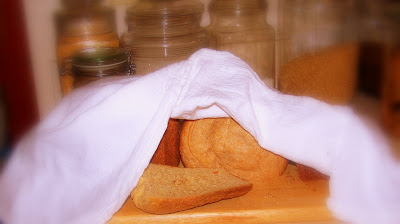
    And Rod keeps us in truly yummy bread every day!

    10 September 2007

    Garden Update

    OK, my lack of interest in the garden has waned some. I am not as obsessive as I was in the spring, but I am able to remember to water and have started taking part in the harvest.

    What's really funny is that the garden bed I sweated and toiled over has been abandoned!


    The tomatoes and zucchinis have all wandered off.


    They're still there -- they've just decided that they want to see the sights. ;)


    That was not something I expected.

    Anyway, we have had a reasonable amount of broccoli and a couple of cauliflower, we have had some very nice carrots and we're overwhelmed with zucchini and tomatoes. (I still haven't found the perfect zucchini bread recipe, but we've started experimenting with shredding the zucchini and freezing it. If that works, then we're home free. The cabbage in the pot is looking happy as can be, though the ones on the ground are definitely the worse for wear. The butternut squash looks like it's going great guns -- we have tried one and it was delicious. Another awaits us on the counter and about 20 of them are growing and ripening on the vine. There is no sign of the eggplant and the buttercup squashes don't seems to have born fruit -- even the one we saw seems to have disappeared. It remains to be seen how the sweet potatoes have done. They look small, but healthy. Maybe they'll have "set fruit" and wee can enjoy them in a few weeks.

    (Too many tomatoes? Easy! Between BLTs, spaghetti sauce, lasagna, and a million other fun recipes, we haven't exhausted our creativity and we also plan to can some.)

    Dad's Home!

    The conference was over a few hours sooner than Rod expected and he got home in time for dinner last night; and Jack was delighted! He hasn't gotten more than a few feet from Rod since he got home and he takes frequent, happy cuddle breaks. It's so sweet!

    09 September 2007

    On our own ...

    Jack and I are pretty much on our own this weekend.


    It's not actually a whole weekend, because Rod didn't leave until about three this afternoon and he'll be back tomorrow evening, but Jack knew he was leaving "for a couple of days" and it had an interesting effect on him.


    From the time we woke up, Jack was "with" me in a way that I haven't experience much with him. It was the normal state of affairs with TJ and Corey -- I was the at-home parent, and then a single parent, and I was their focus when I was around. I've kind of missed that with Jack since I work in an office 40+ hours a week. Rod is always there, so in many senses he's Jack's "main" parent and I am the auxiliary.


    That's not a bad thing, and I am happy that Rod is getting to experience that intense closeness that the primary parent has with his or her children -- and I only miss it occasionally because as sweet as that closeness is, it's also pretty intense. ;)

    It was interesting that he latched on before Rod even left and has been a lot more attentive than he would normally be. He has not really spent any time playing on his own today, which he usually does. Still, I am enjoying this a lot.


    So, by the time Rod left, Jack and I had already started having what Jack later proclaimed "a really good day". We cleaned the kitchen together, cleaned the parlour and put away his toys, we watered the garden and harvested. We made a lovely, large lunch to share with Dad before he left and then we ate. Jack was by my side and involved at every step -- it was delightful! (Oh, Dad was in on the harvesting, too -- and he was in and out of most of the activities before he left-- just like always.)

    After Rod left, Jack and cleaned the kitchen again, wrote a letter to Grandma, and then sat down to piano practice. I am delighted to announce that I can now play (more or less) two-thirds of our first song. (Softly Row, if you're interested. ) It has involved many hours of watching the lesson over and over again, inventing my own system of notation to carry out to the piano, and then practicing, practicing, practicing while Jack noodles away on the other end of the keyboard.

    So far he isn't showing a whole lot of interest in disciplining himself to just practice the song and I am certainly not pushing except to insist that no, he's not playing the piano he's noodling around with the piano. Different thing. I point out that some of his experiments are indeed pretty, but it will take discipline to learn to make the piano make the sounds he wants it to make and that is playing the piano.

    Even so, as he noodles away, he amazingly often seems to get a few notes of the song right pretty much by accident.


    After piano practice, we baked cookies. I thought we were making "Jack's cookies" -- a specific recipe he and Rod have developed over the years, but he informed me that this wasn't "Jack's cookies", it was some other kind of good cookies. Oh well. I discovered that all the recipes are missing from my hard drive, so we had to go with what we had. They turned out pretty well anyway.


    The little guy has adjusted much better than I have to having Rod away for the night. We read two chapters of Wind in the Willows, and he was asleep before I got the book put away. I'm sitting here at 2:15 am. ;)

    But I'd better get some sleep. We have another day to fill!

    08 September 2007

    The Giving Tree: what message does it send to our children?

    A quick look at Amazon.com will see a zillion reviews of this book, spanning the spectrum from “love it” to “hate it”. If you have read the book, its not hard to have an opinion about it.

    For the non-US readership, The Giving Tree is a Shel Silverstsein kids classic in the US which its marketed to small children, the type of thing a parent might read to a two or three year old, if said parent thinks it is suitable at all.

    The story line is about a boy who receives a gift from a tree, and proceeds through all of life to make use of the tree, with absolutely no regard for the fact that he is destroying the tree with his unending neediness, and his voracious appetite for its gifts. The tree continues to give willingly, to its inevitable demise. It ends with a sense of emptiness, but of absolutely no remorse.

    My problem is this.

    Our small children, prior to the age of 8 especially, are really impressionable in a very binary sort of way.

    To the small child, it is simply fact. Small people are needy. People never stop being needy, even when they grow up. A benefactor will supply that need. A benefactor can, will, and should supply that need to the point of its own demise.

    That’s the sum total of the story to the small child. Whatever the parent says before or after is not the same as “the story”, and in the mind of the small child, bears no relationship to the story.

    So, if you want your children impressed from an early age that they must be needy, and that they cannot find their own means to meet their needs, and that they must use up every available resource to no avail to fulfill those needs, read this book to your small children.

    If, on the other hand, you want to impress your children with the subtleties the story has to offer, hand it to them a little while after they start developing strong opinions about how the world should run and how they’re going to fix it.


    The story is a great comment on the consumer culture for anyone over the age of about 10. If you treat finite resources as though they are infinite, you will be empty. So will your world. (Had the needy sad-sack planted some trees instead of feeling sorry for himself, he could have had more than he could use… had the tree stopped giving before it expired, the sad-sack would probably be less sad… and so forth) Those subtleties are completely lost on small children, but are there for the teaching for children in that older age bracket.
    So there is my position on the book. It has some redeeming philosophical subtext, but its definitely not good reading for a small child. The “lessons” of the book are far too complex for the very young to grasp. On the other hand, the example of voracious consumerism is one they are surrounded with every day. The impression that it always has to be that way is, in my not-so-humble opinion, detrimental to the raising of healthy young children.

    I am firmly of the belief that small children live in a binary world, and it is up to us to fill it with useful facts, solid boundaries, and simple values while they take their time to get acquainted with life. As their minds develop, we then develop more complex values with them and eventually teach critical thinking and the art of rhetoric. Expecting critical thinking and complex decision making from small children is expecting too much… but that is a rant for another day.

    Take Care

    Rod

    07 September 2007

    And then, there's the down side ...

    Back in May, Rod and I joined the Family Farm Cooperatives. It's a herd-share coop, where each member owns a portion of the herd, which is the only way we can legally get whole, raw milk in the state of Michigan.

    I had been pushing for several years to join a CSA, but as Rod wisely pointed out, we have a lot of work to do on using fresh produce.

    We tend, out of habit, to use a lot of frozen vegetables, even when we have a fridge full of fresh. It would be a shame to haul that much fresh produce in, only to let it rot because we forgot to eat it.

    So to change our habits, I started buying a lot more fresh produce, and of course the garden has given us a good bit of training in making fresh veg a part of our every-day routine. We're still ot ready for a HUGE box of mixed vegetables every week just yet, but I am not ready to stop pushing, I'm just putting the idea on hold.

    Meanwhile, I brought up the idea of joining a herd-share. We had already been treated to the amazing flavour of really fresh eggs from mostly pastured hens (thanks, Nerida!!!) and so Rod, who had been skeptical a few years before, was willing to believe that there might be a difference in the quality.

    It seemed especially worthwhile since when he first arrived in the US, Rod was absolutely sickened by US commercial meat. The smell nauseated him and when he ate it anyway, he felt dreadful for days. However, Rod isn't built to be a vegetarian and over time, his need for the nutrients he doesn't absorb well from vegetarian sources forced him to adapt to what was available.

    Once he did adapt, though, his health started to deteriorate dramatically. His formerly normal blood pressure soared, he developed gout, and his strength and stamina started to wane. The vibrant, energetic, positive man I'd fallen in love with became tired, ill, and old. We weren't sure what had caused the problem, but the commercial meat that had made him so sick in his early months here seemed like a candidate worth eliminating.

    We started with raw milk. Interestingly, Jack, who has gotten a blistered bottom from pasteurized homogenized milk every time we've experimented, is able to drink raw milk without a problem. (We tried it because I had read that it was often the case that people who can't tolerate treated milks are fine with raw.) Even more interestingly, within a few weeks of trying raw milk, Rod's gout was completed gone. (I don't drink much milk -- just a splash in my coffee in the morning, usually. But I really liked the taste and I miss it when I have to resort to coffee at the office.)

    Then we started trying the meats. They're a bit more expensive so Rod agreed to try them with a certain amount of trepidation. But once we tasted the difference, there was no going back. I had assumed that my taste buds had just dulled over time, but these meats taste a lot like I remember meat tasting when I was a kid.

    Even better, from my point of view, the animals the meats are made from live a natural, pastured life right up to the end. No feed lots, no hormones, no antibiotics, no grains to "fatten them up". They just live as cows and pigs and sheep have always lived, right down to choosing what kind of forage they feel like today. I feel a lot better about that.

    We love the flavours and Rod's health has returned, bit by bit. He has energy to tackle projects and has begun to be that positive, vibrant man again! He says that he has never felt so healthy. Jack seems to enjoy them, too.

    There is a down side, of course.

    We used to celebrate payday by going out to eat. In the days before Jack was eating, we'd choose a cuisine we weren't familiar with and explore. Once Jack was at the table, we started choosing places on the basis of where Jack would find something. That was a bit less fun, but it was still enjoyable, And from time to time, when neither of us had the energy to cook or it was just too hot in the kitchen, we'd dine out, too.

    These days when we go out to eat, not only doesn't it taste as good as cooking at home (that has been the case for a long time) but we all feel mildly queasy for a while afterward. We didn't mention it to one another nor even identify the pattern until the day that we went to Jack's favorite place and he decided as soon as we walked in, that he'd wait till we got home to eat.

    Ahh, well. The price we pay. ;)

    04 September 2007

    Values

    As my favorite astrologer has been explaining to clients for several months now, since just before my birthday, Venus retrograde means values re-examined.

    That transit is coming to an end next weekend, so we can expect the effects to heat up for a few days. What that means in realistic terms, for those of us who don't spend a lot of time watching the stars and being introspective, is that all summer long, a lot of the people around us have been annoying, or annoyed -- or both. That's likely to be even more the case for the next few days, especially if we haven't figured out how our values are shifting.

    It is from the people who have annoyed us most that we have something to learn. If you think for a moment about the people who have annoyed you this summer, you'll probably find it all boils down to one factor, and that tells you something about what you value. Something you may not have been specifically aware of or are not living up to. A value you may not have consciously realized was important to you.

    Now, I have always been a pretty opinionated person.

    This summer, who do you suppose has gotten on my nerves the most? Not opinionated people specifically, but opinionated people who feel the need to preach. People who feel like they need to be "in your face" with their opinions.

    (The corollary is that this summer I have come to deeply respect the handful of people in my world whom I know to have strong opinions but who are confident enough in their opinions that they live them with little fuss. People you have to ask questions of to know what they think about the things that matter most to them.)

    I have been that kind of "in your face" opinionated. I didn't expect people to agree with me, necessarily -- but I did expect them to understand and accept that I had strong beliefs on my pet subjects. Why that was important to me, I can't begin to say. It simply was. (Is?) I didn't feel I was being judgmental, since I was happy for people to have and hold their own opinions and I was happy to hear about why they thought so, but I see now that from the outside that looks like a VERY fine line. The "need to share" at length with anyone in ear shot can come off as intolerance.

    I value tolerance and this Venus retrograde has taught me that I want to be someone who can hold strong opinions while being *actively* tolerant of those with different views. That means not mouthing off so much.

    Can I do it?

    That's another question entirely. I don't know, but I intend to try. Of course I am not promising not to "mouth off" here. I have to have *some* platform to feel heard. But I hereby give you my explicit "permission" to skip anything that doesn't interest you and not to feel that I am judging you if I state opinions that you know I know you disagree with. Unless your opinion is one I see as "intolerant" I probably don't feel that way. My being opinionated is actually all about being heard and understood, and I'll try to make that clear.

    But I sure am glad Venus goes direct next weekend.

    03 September 2007

    Injuries


    These injuries (the back of my hand and my elbow) look like absolutely no big deal.

    Until you understand that I acquired them learning to use a lazy river. Yes, that amusement ride for wimps and old people. That kind of lazy river.

    Have I mentioned that I am not particularly athletic?
    Posted by Picasa

    Reading for Grandma


    Jack needed to read for Grandma this time... This is the"ladybug" magazine he received in the mail the other day, and he starts off reading a cartoon called "mop and family".

    Enjoy!!

    R

    The best day of the month...

    Please excuse the fuzziness of these photos. They were taken through the screen door to capturing a sweet moment.

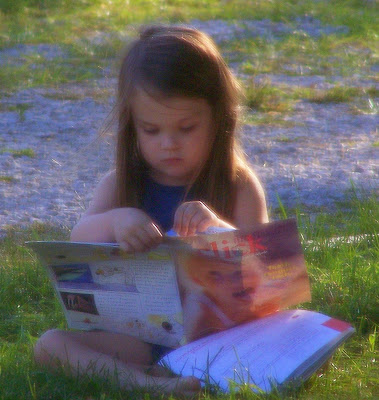
    Every month, Jack gets Ladybug and Click magazines. He adores them -- and when they come, Jack rarely makes it back indoors before he plops down to remove the advertising and then read them cover to cover.

    I keep thinking it's a shame they aren't on an alternating schedule because that would "spread out the joy". But Jack always accompanies us to the maibox -- just in case -- and he *knows* what those magazines look like.


    We are so happy to have spawned such a reader!
    Posted by Picasa

    Walking routine update

    I feel pretty comfortable that my walking routine has become a habit these days. Hot or comfortable, wet or dry, I have managed to walk at least a mile and a half at least four days a week since I got my new shoes.

    I am aiming for two miles a day once the weather starts to cool down a bit more, but I am a bit concerned about how this is going to go once the frigid weather starts. That's months away yet - - and there is an indoor circuit, so it's *possible*. But it means making 10 circuits indoors rather than 2 outdoors. It also means dodging people who are walking to and from meetings and other "official business", so reading is more of a problem, though if I can time it right, I might be able to minimize the dodging part many days. I'll have to make a beaded counter to keep track of circuits, though. Two is pretty easy. Even three gets hard to keep track of -- and with 10, I'd end up confused long before I'd made my daily goal.

    Interestingly, simply walking doesn't seem to be making me feel any stronger. Not the way working out at a gym did. I actually seem to be more achy than I was before.

    Ahh, aging is such a treat. ;)

    More piano

    Well, it's become clear that there isn't a tuner in three counties who is willing to tune our new piano. Turns out that it's not a piano, it's a "pianette". Specifically, it's a Hardman Peck & Co. Eavestaff Minipiano. They are, evidently, not like any other piano in the world - -at least in the tuning stakes.

    It's not in bad shape, other than one sticky key and one dead key -- so Rod is studying up on how to tune this baby himself. It turns out that there are tools he can get for his Mac that will tell him how far out of tune a key is and in which direction -- information that it formerly took a piano-tuner's ear and experience to determine. It won't be a concert pianists idea of tuned, but for now, it'll have to do.

    We also have gotten the idea that Suzuki teachers might not be happy with this quality of piano -- and in any case, we don't have the money just yet.

    But that's Ok. We live in the 21st century. Jack and I spent several hours last night watching various children play "Gently row" on various instruments and we interspersed that with a video of an excellent teacher showing note by note how to play it. Jack ended up out in the parlour noodling with far more purpose than he ever had before. Then he came back and we watched a video of a teacher explaining how to identify the notes, and then the teacher with our first tune again.

    Today, I intend to take notes about where exactly the keys are and I'll practice a bit. (I have been practicing which fingers as we watch the teacher, but that's less than half a start.)

    I don't have any illusion that this is as good as a face to face teacher and personalized feedback - -but it's a a lot better than banging on the keyboard and getting nowhere. An this is pretty much my idea of how homeschooling works - -we want to know, so we go find out. When we reach the point where we can find a teacher (that we can afford) who can do what we can't do for ourselves, then we'll take that route. For piano -- and for life.

    01 September 2007

    The new piano


    Posted by Picasa

    30 August 2007

    Music Man

    From well before he was born, Jack has loved music.

    When we went to circles where there was drumming while I was pregnant, Jack would "dance" as long as the drumming lasted. When we were around music loud but less rhythmic music, he would be very, very still while the music played and then he'd wriggle and thump until the next piece started.

    When Jack was four months old, we took him to his first concert. Fruit, an indie band from Rod's hometown was playing at the Ark in Ann Arbor, and so we all went together. I was startled at his response -- he was so little that I expected him to sleep through much of it, and I had expected to walk outside for at least part of the concert. But Jack was just mesmerized for the entire first set! It's hard to say what he was experiencing or thinking, but his eyes never left the stage and he squirmed anytime he couldn't see. He also kicked and squirmed between pieces until he was satisfied that the music wasn't stopping. (When we took him again the next time Fruit visited a year later, Mr. Jack was more interested in singing along than in listening, so we went outside and listened through the speakers.)

    Jack plays music most days. He turns on the stereo or he seeks out music on his computer and then he dances, or he brings out his percussive instruments and plays along. He has a little electronic keyboard attached to a book of music. You know, the kind with dots to represent the keys required to play the song... He plays that and sings along, trying over and over again to get the right key with his voice and the right rhythm with the keyboard. His persistence is amazing.

    Given all this, Rod and I had been considering getting Jack music lessons. Jack's Goddess Mother, Dame, suggested Suzuki. She had taken Suzuki violin as a child and thought it extremely worthwhile. Interestingly, both Dame and Rod felt that piano was more useful for all the benefits that music offers a growing brain. (I had wanted to learn to play since I was a small child and first discovered the piano in my Aunt Elsie's parlour!)

    We looked into it, but Suzuki teachers don't consider an electronic keyboard "good enough", so we figured it'd be a while before we could afford a real piano and then the $3000 a year + for the lessons. Mind you, they sound wonderful and we are going to find a way to do it -- but maybe not this summer.

    Then, yesterday, Rod and Jack went to give a hand to an acquaintance who found herself in, shall we say, an unfortunate domestic situation. Somehow or other, she came to give Jack her piano. Really! She just gave it to him -- all we have to do is move it! Jack was in tears at having to leave "his" beautiful piano behind. He was blue most of the evening, and last night he spent a long time working with his tiny keyboard and singing.

    We called around and found that we can get it moved just just slightly less than the amount covered by the unexpected check from our insurance company, which currently resides in Rod's wallet. So, of course, we're going to do it.

    I'm not sure where the money for the lessons is going to come from, but I have a hunch that as with anything else Jack wants this badly, it's going to work out somehow.

    26 August 2007

    Library, Homeschooling, and Unit Studies

    OK, back to what I started out to say about libraries and homeschooling. (I got sidetracked -- I do that a lot these days.)


    Anyway, Jack has announced that he wants to start schooling at the age of six. Um...OK. Fine with me.

    We plan to do classical home schooling combining Well trained Mind curriculum with Charlotte Mason methods, and we hadn't really planned to start doing anything formal before age six or so.

    We do read with Jack quite a bit -- both literature from the Charlotte Mason lists we find around the Internet and non-fiction about things that interest him. (And now, with the library, also some "twaddle" that I wouldn't choose for him but see no need to forbid.)

    But his announcement that he plans to wait hasn't reduced his interest in anything and everything. *(Leaving me to wonder what "school means to him...)

    So, I am following him on his whimsical journey, and using "unit study" ideas to help him expand on his interests. He took a serious fancy to soccer for a week or so after we went to the park and saw some men playing. He sat down on the bleachers and watched for over a half hour and he talked about soccer constantly for several days. So, I printed some clip art soccer pictures out on my computer and invited him to write a story -- he dictated the story and Dad scribed it. It was the first entry into "his book". A week or so later, he wanted to dictate another story to me on the computer. He dictated his own wandering version of Red Riding Hood, we scanned the Internet for an appropriate drawing, printed it, and it was the second story in his book. It's my intention that he will "narrate" what he is learning for us every time he gets a fancy and we will put the narration in his book. As he gets older, the narration will become more formal, but this is excellent practice.

    As I mentioned earlier, his current fascination is with mountain gorillas. He has read his book about Koko and watched videos of Koko and other mountain gorillas. He has listened to clips of the sounds that gorillas make and we have read a bit more about them online. Later today or maybe later this week, I will ask him to tell me what he knows and we will transcribe what he has to say.

    The library means that Jack will have plenty of opportunity to take an interest in any topic that crosses his mind. I think this may be some of what Holt referred to as unschooling...? Certainly it sounds like it in what I have read.

    So, we aren't in a hurry, but to be successful, homeschooling can't be something a family "does" -- it's a lifestyle choice, and so far, the lifestyle is going great guns!